Spiritual Canticle in Irregular Verse: O Radiant Dawn

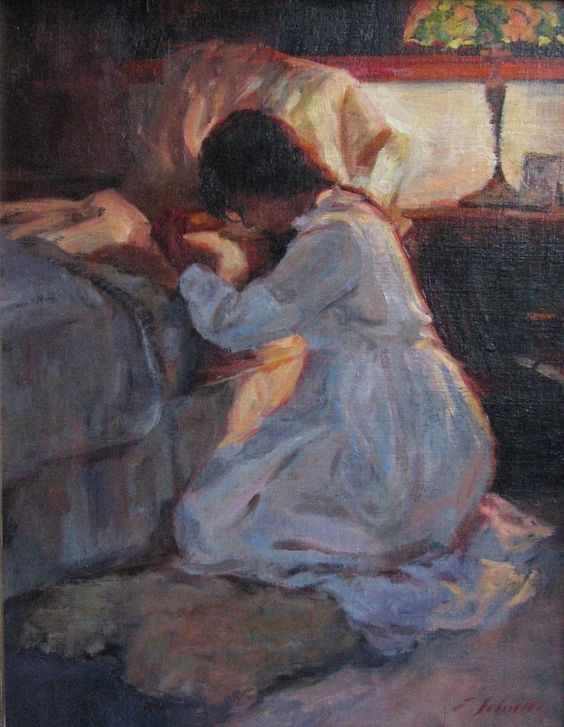
Out of the darkness of this life
the wasteland held captive by gloom's shadow
where there dwell frustrated hopes and dreams dashed against flint
the unwearied Father places upon the weary dust
the one great thing to love on earth: the Blessed Sacrament.

The small white Sun ablaze with love
whose radiant joy springs over the hills,
bathing the valley in undimmed light,
wakes the lover asleep with grief:

"Arise, my beloved, my beautiful one and come!
Forget your people, come to my Father's house.
I, the King, desire your beauty -
Come swiftly, my friend.

"See the beams I pour as ointment on your wounds,
my light which is poison to the foxes in your yard.
Come, dear heart, they can harm you no more -
So long as you abide in my arms.

"Awake, sweet dove, let me dry your teary eyes.
Let me show you the garden prepared for our paradise.
The winter chill has burnt you, left your heart exposed and raw -
But see the lily springing from my open, bled-out side.

"Arise, my lover, see how my dawn 
has thawed your rigid heart.
My light has banished wet and dark -
The rains are over and gone.

"The flowers appear on the earth
to crown our thorn-pierced heads.
Did you forget, sweet daughter of Eve
as you waited in the rain,
that I promised, "I make all things new?"
Come, lose your life -
You've the Sun to gain."

“Out of the darkness of my life, so much frustrated, I put before you the one great thing to love on earth: the Blessed Sacrament. . . . There you will find romance, glory, honour, fidelity, and the true way of all your loves on earth, and more than that: Death.” – J.R.R. Tolkien

Wreck My Life: O Key of David

O Key of David, O royal Power of Israel controlling at your will the gate of Heaven: Come, break down the prison walls of death for those who dwell in darkness and the shadow of death; and lead your captive people into freedom.

Today’s antiphon reminds me of the bridge to the popular worship song, “Reckless Love:”

There’s no shadow You won’t light up

Mountain You won’t climb up

Coming after me

There’s no wall You won’t kick down

Lie You won’t tear down

Coming after me

I love my Jesse tree and candles and Blessed is She Advent wallpaper. But sometimes we use the physical manifestations of our Advent devotion as a facade over the chains shackling our heart. I’m all for cozy candlelit meditations on “holy infant, so tender and mild.” But the unspeakable power and jealous love of the King of Kings is also central to the mystery of the Incarnation. The feast we are about to enter isn’t just the celebration of a birth. It’s the celebration of a prison heist and rescue mission of the greatest proportions.

There’s an interesting contrast within the imagery of the antiphon. Christ’s title is “Key of David.” But rather than ask Him to unlock a door, we beg Him to tear down a wall. By Christ’s Incarnation and bestowal of grace through the Sacraments, He has unlocked the prison in which we were trapped by original sin. But the gift of our free will is still intact. We can still choose to sit in prison. Maybe we’re in a state of grace, congratulating ourselves that we’re not like those tax collectors. But Christ didn’t come just to make sure that with one confession per year, we can slide our way into heaven. He “came so that [we] might have life and have it more abundantly.”1

We are too weak to leave our cells. So we ask the “royal Power of Israel” to break down the prison walls and to flood the shadow of death with His luminous light. We ask Him to do whatever it takes to drag us from captivity and run into His joyful Kingdom.

It’s going to require sacrifice. It’s going to require an intense openness in prayer and the courage to let the Lord bring those wounds into the open so that He can tend to them. The Lord delights in your hand-painted Jesse Tree ornaments2 and faithful recitation of the St. Andrew Christmas novena and organization of the St. Nick’s party for the homeschool group. But He’s asking you to go deeper, to press into the messy beauty that each of these traditions holds. The Jesse Tree tells the story of mankind’s adultery and ingratitude against an infinitely faithful Spouse and Father. The St. Andrew novena is a prayer of desperation before an impoverished God. We give gifts in honor of St. Nicholas because he preserved women from the horror of prostitution.

In these last days of Advent, we are asking the Key of David to unlock the doors in our soul that we are too afraid to enter. We are asking Him to smash and burn the idols to which we offer our love. We are asking Him to come with His power and preserve us from every stain of sin, not just mortal sin. “Do whatever it takes,” we whisper to the Messiah. “Open the enclosure in our hearts so that we can enter into intimate communion with you.”

My life changed when I prayed, “Jesus, I give you permission to wreck my life.” The joy and heartbreak that has flowed from that prayer has been confusing, painful, and unexpected. But it has changed everything. Christmas changes everything. Let Him break down the walls.

Batter my heart, three-person’d God, for you
As yet but knock, breathe, shine, and seek to mend;
That I may rise and stand, o’erthrow me, and bend
Your force to break, blow, burn, and make me new.
I, like an usurp’d town to another due,
Labor to admit you, but oh, to no end;
Reason, your viceroy in me, me should defend,
But is captiv’d, and proves weak or untrue.
Yet dearly I love you, and would be lov’d fain,
But am betroth’d unto your enemy;
Divorce me, untie or break that knot again,
Take me to you, imprison me, for I,
Except you enthrall me, never
shall be free,
Nor ever chaste, except you ravish me.

-John Donne, Holy Sonnet XIV

1 – John 10:10

2 – Yours, not mine. Heaven knows I’m not the crafty type.

Beauty Incarnate: Flower of Jesse

O Flower of Jesse’s stem, you have been raised up as a sign for all peoples; kings stand silent in your presence; the nations bow down in worship before you. Come, let nothing keep you from coming to our aid.

You are made for beauty.

You are created to experience that thrill when you see the first pink buds peeping out of snowclad Narnia in The Lion, the Witch and the Wardrobe. You are intended to be moved by the radiance of a bride on her wedding day. It is good when you gape at the stars or weep over a symphony or smile at the scent of herbs. It’s not necessary – I’m just a melancholic who has no category for anything other than intense emotion. But there is nothing wrong with letting beauty move you.

In a way, today’s antiphon is a short, but powerful exposition of beauty. Beauty is “raised up as a sign” of the happiness and harmony for which we were created. The most beautiful images or moments leave the beholder “stand[ing] silent in [their] presence.” In the myth of Psyche and Cupid, the ancients who worshipped Psyche for her beauty weren’t entirely misled. Beauty is intended to lead us to worship. If our intellects shrug it off as sentimentality, our souls know that “Beauty will save the world.”1 So we turn to beauty and beg that nothing keeps it from coming to our aid.

Of course, the beauty of a flower or song cannot save us with its own power. But the source of all beauty hears us. The true beauty is “the true light, which…[is] coming into the world.”2

The reason that we love flowers is that we loved the Flower of Jesse first. We are created in the image and likeness of God, for the purpose of knowing, loving, and serving Him. And since God is Beauty, we are made in the image of perfect beauty, for the purpose of pursuing beauty with every fiber of our being.

Through the mystery of the Incarnation, beauty makes a way for us to be united with Him. The beauty for which we long has a name, a face, a voice. St. John Paul the Great writes, “[Jesus] is the beauty to which you are so attracted; it is He who provoked you with that thirst for fullness that will not let you settle for compromise.”

Today’s antiphon assures us that the hope we have been clinging to throughout winter is not in vain. We are created for everlasting delight, “to be united with the beauty we see, to pass into it, to receive it into ourselves, to bathe in it, to become part of it.”3

Not only are we created to delight in beauty, but we are created for beauty’s delight. Zephaniah proclaims, “On that day, it shall be said…The Lord, your God, is in your midst, a mighty savior, Who will rejoice over you with gladness, and renew you in his love, who will sing joyfully because of you, as on festival days.”4 As we pray for an increase in hope as we await Christ, let’s pray for the awareness that the Flower of Jesse comes because He loves us.

1 – Fyodor Dostoevsky, The Idiot

2 – John 1:9

3 – C.S. Lewis, The Weight of Glory

4 – Zephaniah 3:16-18

Our Lady and the Burning Bush: O Adonai

O sacred Lord of ancient Israel, who showed yourself to Moses in the burning bush, who gave him the holy law on Sinai mountain: come, stretch out your mighty hand to set us free.

We worship a God who turns water to blood and sweeps sea from land. He is so close that He knows our suffering (Ex 3:7) and yet is so beyond creation’s comprehension that even Sinai trembles before His presence. This marvelous Lord is the One who made that first covenant with Adam and Eve in Eden. But our parents bought into the lie that God wasn’t worthy of all their trust. So they ran into the bushes.

In response, God came to Moses in a bush, promising redemption for Israel and affirming that He was worthy of His people’s trust. From this bush, He revealed His name and sent Moses into Egypt as His forerunner. When He came down to Egypt, He put the Egyptian gods to shame, stretching out His mighty hand for the sake of Israel, His firstborn.

In return, all He asked was that Israel remain loyal to Him and that they keep His law. But the same distrust that sent Adam and Eve into hiding had been passed from generation to generation. As soon as Moses was on Sinai for too long, the Israelites turned to a golden calf for security. And oh, how they suffered for breaking the law.

It’s easy to make fun of the way that the Israelites whine in the desert, or to dismiss as historical trivia Israel’s inability to keep the Torah. But you and I are also sons of Adam and daughters of Eve. The same venom blackened our souls when we were conceived. Our first cries at birth joined with the cries of enslaved Israel.

But there was one first breath that was not fouled by the adder. There was one soul whose timing for redemption was magnificently different. The mighty Lord formed from the dust of the earth a daughter. He made her soul so pure that His Spirit could hover over the waters of her womb without any resistance.

In the fullness of time, the daughter mirrored Her Creator’s “Fiat lux” with her own song of “Fiat mihi.”1 The living flame of love rushed upon her whole being, and Mary, conceived without sin, was on fire, but not consumed.

This luminous vessel carried Love Himself inside her body for nine months. Beneath her breast, Love traveled the hill country to a town of Judah, where He entered the house of Zechariah and His Mother greeted Elizabeth. In the silent power of the womb, the divine Flame purified John the Baptist and set Him apart to be His forerunner, to tell Israel that its Savior was coming soon.

But the first time He stretched out His arm was not to send Herod flying into the waves. He stretched His tiny arms as He lay upon straw. The thunder from Sinai was replaced by a wail from a cave.

This is the mystery we will celebrate in just a few days. The Lord who hears our cries comes down to cry with us. And when we fall beneath the burden of our concupiscence, He gives us His mother. She is the burning bush who unveils our vocation with just one word of greeting and carries us back to Christ when we stray from that path. Let’s ask her intercession as we prepare for the birth of her son and Messiah.

1- “Let there be light, (Gen. 1:1)” “Let it be done unto me (Lk 1:38)”

Merciful Wisdom: Introduction to the O Antiphons + O Wisdom

O Wisdom, O holy Word of God, you govern all creation with your strong yet gentle care. Come and show your people the way to salvation.

A favorite Christmas memory in our house is when my younger sister was about four and we were opening gifts on Christmas Eve. Surrounded by fun cousins and fueled by inconceivable levels of sugar, Ieva was in a state of pure frenzy. As she waited for her turn to open gifts, Ieva began to cheer on her younger cousins as they opened their presents, yelling incomprehensible phrases like, “Blow out the candles!” “Make a shout!” “Cuddle up!”

The anticipation of Christmas Eve is something we all remember. Secular culture tries to keep it alive through nostalgic movies and “Believe” sweatshirts. But society has nothing on the Catholic Church when it comes to building anticipation.

The Church doesn’t see anticipation and excitement as cozy nostalgia for Christmas days gone by. Rather, this anticipation is central to the Christian life. In a world deadened by noise, stress, and mind-numbing pleasures, we need to be shaken awake. Our weary souls need to experience that “thrill of hope” of which the famous carol sings. We need the reminder that there is overwhelming joy ahead.

That joy is just days away. St. Bernard of Clairvaux writes that there are three comings of Jesus. We’re familiar with that first coming in Bethlehem, as well as the second coming at the close of history. But the third, “intermediate coming” of the Lord is a private entrance into the hearts of His followers:

“The Son with the Father will come to you. The great Prophet who will build the new Jerusalem will come, the one who makes all things new. This coming will fulfill what is written: As we have borne the likeness of the earthly man, we shall also bear the likeness of the heavenly man.

Christmas is not a mere remembrance of the past or a fervent gaze towards the future. It is an opportunity for intimate encounter with the incarnate God. Wisdom clothed in weakness softly kisses us at Christmas Mass. His words of truth breathe warm courage into our frozen souls.

Every Christmas, Christ is born again in our hearts. That’s why we spend nearly four weeks in Advent preparing ourselves for this sacred encounter. Even the secular world knows that Christmas is not instantaneous. Our earthly celebrations require planning ahead and the investment of time, talent, and treasure.

But I’m suspecting that you just read that paragraph and sighed because heaven knows, you haven’t prepared well enough for the glorious mystery of the Nativity. Me neither. I spent the first half of Advent far more worried about the apocalyptic nature of finals week than the apokalypsis of Midnight Mass.1

We little humans are so foolish about the idols we worship, the worries on which we fixate, and the way we spend our time. But our Lord is Wisdom Himself. Our weakness and inanity is no surprise to Him. He knows that any initial zeal at the beginning of Advent has at least been tempted to grow lukewarm. So in his “strong yet gentle care,” He offers us this beautiful period from December 17-23 to increase our excitement for Christmas by meditating on seven different titles of Christ. These titles appear during Evening Prayer in the Liturgy of the hours, in the antiphon before and after the Magnificat.2

Through the O Antiphons, we spend seven days marveling and wondering over this Savior we will meet at Christmas. We are swept up by His beauty and our hearts are invited to ache with joy rather than drudgery. But while these ancient prayers are solemn, they are also the Church’s equivalent to Ieva’s giddy anticipation of her forthcoming gift – I have seen the girl literally bounce back and forth between walls on Christmas Eve.

That is the childlike excitement we are all called to as we near the intermediate coming of Christ. Tonight, join me in praising the omnipotent Wisdom who is so wildly in love with His creation that St. Catherine of Siena calls Him the “Divine Madman.” Let’s praise Him for His mercy in crafting the liturgical year so that it guides our wayward hearts back to His side. And let’s stop being foolish grown-ups, but instead cast ourselves into the childlike joy and excitement to which we are called in these last days of Advent.

P.S. Wow, hello, dear reader! Goodness, it has been a minute. Since my last post, I’ve completed my summer as a Totus Tuus Missionary, moved to Texas, finished my first semester at University of Dallas, and returned home to Indianapolis for Christmas break. I guess you could say I’ve been a little busy. While I haven’t had the time to write on here in a while, I have been writing commentary pieces for the University News at my school. You can view those here. I’m grateful for the extra time to write on here during break!

1- Apokalypsis – Greek, “Unveiling”

2- This is a great time to get acquainted with the Liturgy of the Hours! The iBreviary app has the official translation for free. Maybe try out Office of the Readings, Evening Prayer, and Night Prayer for a nice little liturgical charcuterie board.

Sunday Gospel Reflection: Rocking Eve to Sleep

I wonder what it was like for Jesus as His bleary eyes woke from sleep. He could feel the water lapping at his feet, hear the roar of the wind skidding over the sea. But the first thing He saw must have been the disciples’ faces, their wide eyes dimming with despair and confusion. Before he heard the waves bludgeon the deck of the boat, he heard their desperate cry cracked by the blade of mistrust: “Teacher, do you not care that we are perishing?”

How His heart must have broken at the fearful wail of His children. How His heart continues to break today as we too cower and scream, “Do you not care?”

As He woke from sleep, the Word’s human eyes witnessed the fear and lack of trust that has haunted humanity since Eve’s eyes first looked into the visage of the serpent. The venom from that glance has oozed into every human heart, turning us from bold children of the Lord into terrified creatures who shrink at the sight of waves. Many of us have been infused with faith since our baptism as infants. And yet have we practiced this virtue to the point that we can look at Christ’s closed eyes and boldly trust in Him?

Today’s Gospel might not describe a physical healing. But the Teacher asleep on on a cushion yearns to heal our angry and frightened souls. He desires to calm our hearts that churn far more violently than any squall. How does He desire to heal us? By closing our eyes.

It was Eve’s eyes on the Deceiver that ultimately drew her and the whole world to destruction. It was the disciples shaking Jesus’ eyes open that displayed their lack of faith. Today, our merciful Master invites us to reverse this habit and choose to instead rest against His heart. We too are invited to sleep in the peace of the Father, a peace that may not understand why the storm wails but which nevertheless believes in unutterable love and providence.

Friend, I don’t know the storm that threatens to capsize your boat. I don’t know why Jesus remains asleep when He could vanquish the squall with one command. But I do know that He cares. He cares so much that His eyes closed on the Cross as He embraced the sleep of death. But He did not perish forever. His eyes opened in glory. They opened for you and gaze upon you right now.

On this Sabbath, rest with Jesus. He will wake you when the time is right. He will not let you perish.

The Game is Never Over, John: BBC’s “Sherlock” and the Common Human Experience

If you sign into Netflix, you’ll see a sad sight. More accurately, there’s something that you won’t see. As of last weekend, BBC’s Sherlock has gone away. Netflix is no longer 221 B Baker Street.

I’ll admit that I’m more Sherlocked than most. I don’t think many people were mourning its Reichenbach fall from Netflix like I did, drinking coffee at 2 am while hurriedly finishing the entire show for the umpteenth time before it departed early in the morning on May 15th. The show predates the excitement and publicity surrounding Netflix originals. Its nerdy fans mostly bonded and connected over Tumblr, the social media platform that hearkens back to the first societal hit of social media buzz. But despite its accelerating old age in an era of instant releases for streaming, Sherlock is still widely considered to be one of the best shows to grace Netflix and 21st century TV. Not only that, but it holds deep emotional value for the fans who grew up with the show. I started watching Sherlock in 8th grade, one of the hardest years of my life, and have loved the show ever since. When I saw that it was leaving Netflix, I experienced a sense of loss even though I hadn’t watched the show in ages. No matter what was happening in life, Sherlock was always available. It always brought comfort.

I don’t think those sentiments are wrong to have. TV can be used as a drug, something to numb out pain or stress and allow for separation from real life. But TV shows can also be a form of modern art. Modern art tends to use beauty to provoke and ask a question. Sherlock is no exception to this. At the heart of Steven Moffat and Mark Gatiss’ take on the legendary sleuth lies the question: What is it to be human?

The director of my high school Great Books program loves to probe the topic of the common human experience. Odysseus is really not so different from the 14-year old student first stumbling through the churning pages of Homer. When Solomon wrote, “There is nothing new under the sun”1 thousands of years ago, he was living in the same fallen world surrounded by the temptations, joys, and loves that we human souls experience even in the 21st century. That question of the common human experience is critical to anyone navigating life and earnestly seeking after virtue and authentic happiness. And it’s not just something we learn through Aristotle and Shakespeare, but also while tracking serial killers with Sherlock and John.

The way that Sherlock explores the common human experience2 is rather ingenious. In the pilot episode, Sherlock is true to his self-proclaimed identity as “a high functioning sociopath.” He seems like more of a robot than a man, “A bit of a weirdo, if you ask me.”3 Sherlock may be a consulting detective of the highest caliber, but the man is also a painfully awkward and sadistic loner who remains impenetrable to both the hatred and affection of others. But through his adventures and more importantly, his growth in friendship with John Watson, Sherlock slowly learns what it is to be human. The writers of the show are able to portray the facets of the human soul individually, as we see a previously cold man experience friendship, loyalty, passion, rage, betrayal, broken pride, heartbreak, and love for the first time that he can remember.

As a viewer, watching Sherlock develop can be conflicting. Yes, it’s deeply moving to watch him sacrifice himself in The Reichenbach Fall (well, when we learn it was a sacrifice and not an act of despair), but when we see just how much he adores John and Mary and endure his meltdown over Molly in The Final Problem, we find ourselves squirming because Sherlock isn’t supposed to be like that. He’s supposed to be the calculating machine that Scotland Yard resorts to, not a man who needs his friends and who is capable of romantic heartbreak. It’s argued that the show began to go downhill as soon as Mary, John’s wife, entered the story. And while it’s true in my opinion that the final series was far less polished than the previous series, I think that part of our collective criticism is that we didn’t like it when Sherlock became less of a computer and more flesh and blood. We don’t like things as much when they’re real, when they’re messy. “Love is a…vicious motivator,” Sherlock claims in A Study in Pink. That vicious quality of the human soul isn’t welcome in a society that is fixated on control.

But no matter how much we idolize control, it’s generally a facade within the common human experience. The audience can’t help but feel sorry for John, a man who is so desperate for a quiet ordinary life, but is surrounded by an ever-growing list of sociopaths, criminals, and special agents for comrades. His brilliant best friend also shares in his powerlessness to an extent. No matter how incandescent Sherlock is, he still can’t foresee every move of his adversaries. And he has no control over that East Wind that had unknowingly haunted him his whole life, the lost sister who killed his childhood best friend and left him shattered and unable to love.

Yes, the experience of crippling grief and broken trust is a central theme explored in Sherlock. The two unlikely flatmates would never have met if it wasn’t for the toll that trauma had inflicted on them both. Over and over we see John lose loved ones and feel our own hearts strain as he returns to his alert, soldierly stance in the cemeteries of Sherlock and then Mary. We witness horrible deeds committed not only by criminals, but in Mycroft’s betrayal of Sherlock, Sherlock’s forgetfulness or schadenfreude in not telling John about his fake suicide, and John’s infidelity to Mary.

But in those moments when control is lost and suffering is imminent, when Jim turns the gun on himself and Sherlock learns that he has lost to Magnussen, viewers are invited to contemplate the higher aspects of the common human experience. We see Sherlock risk his life and sacrifice his reputation to save John’s life. We are privileged to glimpse Molly’s steadfast charity and feminine genius, even in the face of ingratitude. We hear John forgive Mary for what most would deem unforgivable. We catch our breath at Mycroft’s instant willingness to die in the place of John during The Final Problem. We weep when Mary takes the bullet for Sherlock. Over and over, we see men and women lay down their lives for one another and demonstrate the fiercest loyalty and deepest friendship. We see heroism.

However, the final lesson of Sherlock is not merely about heroic deeds. It is about the vital need of all heroes for beauty. The final spoken words in the series4 come from Sherlock’s mother after she learns that Eurus is in fact alive, but physically and mentally unreachable. “What are we to do?” she asks Sherlock.

Sherlock – no longer a broken machine, but a man, a friend, and hero – responds by playing music. Through his violin and his invitation to Eurus to join him in experiencing and creating beauty, he gives both of them permission to heal. Sherlock’s deductions can solve a murder and John’s intuition and experience can save a life, but it is beauty that offers restoration. It is beauty that unlocks the innermost cells where scarred and scared prisoners hide.

Sherlock shows the ugliness of humanity. We take a glimpse into the most depraved criminal minds and are forced to be witnesses of heinous acts. But we also peek into broken hearts as they heal, are witnesses to the first genuine smiles of Sherlock and John, and see that love is not a passion, but the highest virtue. In Sherlock we are taught that while the game afoot may be dangerous, it is truly beautiful to be human.

The writers of Sherlock ask, “What is it to be human?” The answer that they offer is so intricate and so marvelous that only music is capable of whispering it.

1 – Ecclesiastes 1:9

2 – (which I started abbreviating as CHE in my high school notebooks because of how often we talked about it)

3 – Chief Superintendent, The Reichenbach Fall

4 – Not counting Mary’s voiceover

That Last Paragraph, That First Death

I’ve been preparing for this post for months now. Thinking about possible ways to open it, staring at a blank screen and aggressively blinking cursor, saving drafts that I’ll never reopen.

My favorite part of a book is always the end. It’s that final sentence or paragraph, the final goodbye from an author to his reader that leaves me breathless and yearning for the transcendent. I choreographed an entire dance to depict the ending of Evelyn Waugh’s Brideshead Revisited. I wept over the end of Jane Eyre and stomped my foot in confusion over the last paragraph of Lewis’ Till We Have Faces. Even that last “I Do” in The Fault in Our Stars was enough to make me curl up in a ball and cry cathartic tears.

And that’s why we love a good ending to a story, don’t we? Our hearts are made for an end, for the “place called ‘heaven’ where the good here unfinished is completed; and where the stories unwritten, and the hopes unfulfilled, are continued (J.R.R. Tolkien).” But I rely on the masters like Waugh and Cather to weave breathtaking denouements. It’s one thing to muse on where Julia goes after Charles leaves Brideshead. It’s quite another to reach the end of a chapter in your own life.

And that’s what this post is about: This Fall, I’ll be attending the University of Dallas to double major in English and Theology. I’m setting my pre-professional ballet days behind me.

I could list a million reasons for why I’m going to school next year. Tell the stories from high school retreats, explain what was stirring in my soul while watching The Chosen, share the podcast episode that opened my eyes to what the Lord was doing in my heart, gush about the middle schoolers I got to work with this year who helped me to see that serving them is all I really want to do with my time. But none of those reasons or “pieces of data,” as Fr. Mike Schmitz would call them, are enough. Ultimately, there’s only one answer – the One who utters no answer, but is Himself the answer.1

If there’s one thing I’ve learned over the last fourteen months and through the profound, agonizing invitation to the Cross that I’ve experienced in so many ways, it’s a deeper confidence that He is so trustworthy. I look at all the doors that should have been closed to me and have been unlocked, all the little and big dreams that have been fulfilled (right down to teal blue kitchenware in my house), and even the doors that were slammed so excruciatingly, but have become vessels of mysterious grace. The author of life is not only faithful and wise – He is so gentle. And if He is ready to begin singing a new chapter of my life into creation, I’m ready to magnify that voice.

That voice knows me so intimately. During the Holy Hour when it was indescribably clear that I was going to go to college next year, I heard the Lord say, “Your heart cry is mine.” And what is my heart cry? It’s the cry of every artist who has set a brush to canvas, who has stepped onto a lit stage, who has choreographed movement or written a score. It’s the cry of the mystic, the song of John’s impassioned “nada,” Augustine and Monica’s draft at the fountain, Aquinas’ fingers holding straw. It’s the cry of the beloved who won’t settle for anything less than seeing the whole world set on fire for Jesus Christ. It’s the cry that Dostoevsky composes into words when he writes, “Beauty will save the world.”

The reason that I decided to spend this year in a trainee program was beauty. The reason that I’m leaving the trainee program is beauty. We need the arts. We need faithful Christians in the arts. But we also need artists to work for the Church, men and women who see the Host in the monstrance as unadulterated light and beauty, the fulfillment of every good and true dance, painting, and film.

At the moment, I want to go into youth ministry as a career, although that could certainly change. I’ll be spending the summer as a Totus Tuus missionary in the Archdiocese of Cincinnati, teaching kids during the day and running teen nights in the evening. I’m so excited to hit the ground running this summer and my nerdy heart has honestly been pining to get back into the classroom this Fall. But Jesus has crafted my heart in the way that He has for a reason. He has made me an artist, and switching from an emphasis on the art of ballet to the art of writing isn’t going to change that.

That also means I’m reacting to this transition as an artist would (kudos to you if you’re still reading this overly long outpouring of thoughts and emotions). For the last several weeks, as the calendar ticks down the days to my last performance, I’ve been thinking about a quote from Martha Graham, the mother of modern dance:

A dancer dies twice — once when they stop dancing, and this first death is the more painful.

How do you prepare to die? How do you dance when your days in the studio are numbered? You can feel peace and joy about a decision, but still catch your breath when, like Mary of Bethany, you see the oil of your offering spilled all over the floor at Christ’s feet and realize that there’s no turning back. Choosing between ballet and college has been the most difficult decision of my life. I was talking to a teacher about it the other day and began to tear up. “Sorry, I don’t know why I’m crying,” I muttered.

“No,” she said so gently. “Let yourself cry, please. Let yourself grieve and feel whatever you need to feel. Because this has been your first love and of course it’s a big deal to walk away. But don’t walk away completely. Stay connected.”

She is so right. This isn’t the end. It’s only the close of a chapter, the step into a new act. Even though it’s going to look different, I will never stop dancing. My heavenly spouse will never stop wooing my heart with the beauty and faerie that He has always used to draw me to Himself. Ballet may be my first love, but He is the Love who was always whispering to me in the wings and at the barre. And I can’t wait to share His love with others through a new form of ministry.

He is the Love calling my name. His heart cry is mine. And with a beauty like His, “you can overturn the world.”2

1 – cf Till We Have Faces, C.S. Lewis

2 – The Idiot, Fyodor Dostoevsky

The Hidden Worker

They have barely reached the peak of Golgotha when His clothes are violently torn off, leaving only open shreds where skin should be. Jesus staggers right and left as his hunched form is prodded towards the cross by clubs. He kneels beside the cross as one last time, His Sacred Body touches the dust that He created. Now is the moment for which He came to earth. Here is the wood for the sacrifice, and here is the lamb.

Surrounded by mockery, He lies down on that precious wood. Every movement is agony as the Victim and Priest stretches Himself out against the cross. Jesus’ left arm extends, His palm stretched open to heaven. “Here I am, Lord,” He breathes. “This is my Body,” He whispers to His Bride.

Jesus looks sideways, into the eyes of the soldier who will not look at Him. He feels the edge of the nail against His wrist. And then He feels what cannot be described.

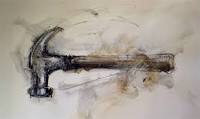
He hears the hammer so close to His ear. Over and over it screams as it delivers its blows. But He has heard this sound before. “Father,” He cries in His torment.

In His moment of deepest pain, Jesus thinks of His foster father, Joseph. He brings to mind memories of His father at work, when Jesus’ little eyes were wide with awe at the strength of His dad who could haul giant pieces of wood and craft them into homes. He remembers the song of the hammer, the percussive score that played in the background of His entire childhood. He remembers watching Joseph drive the nails into the wood in swift and sure movements.

Jesus remembers when Joseph first taught Him. How He was so eager to place the two pieces of wood on top of each other. How Jesus had moved His thumb too quickly and felt the piercing pain of a nail for the first time. Tears had sprung to Jesus’ eyes, but they were wiped away so quickly by Joseph’s kind hands. The pain vanished as soon as Mary kissed that little thumb.

Mary and Joseph stood side by side that day to console their hurting child. But now Mary kneels alone. She is only able to watch as a wound is inflicted that will never close up, but will be glorified. Today however, there is no external glory. There is no comfort she can offer Jesus other than her presence and other than the hammer song that she and Jesus both know so intimately.

Joseph was there to hold Mary’s hand when Simeon foretold the revealing stab. But now as she feels that sword sink into her heart, there is nobody to help. The woman who watched her husband die now watches her son prepare to breathe His last.

They were both there when Joseph left this life. They both cradled him like a child, not letting go until his chest had stopped rising and falling and the fear had disappeared from his face. As their tears mingled in an embrace, Jesus had explained to Mary that they would see Joseph again, that He Himself would lead His foster father into the embrace of the heavenly Father. Here on the cross, that momentous occasion is only hours away.

The Son accepts the nails for the sake of the one who first taught him to hammer. Because of righteous Joseph, a man who was imperfect and yet a true son of David, the sound of the hammer blow becomes a consolation in the midst of unfathomable anguish.

In His humanity, Jesus has never tasted death. The dread of Gethsemane washes over Him once more as a nail is driven into His right wrist and His feet are shoved into position for theirs. But then He thinks of Joseph, the man who had protected and provided for and loved the Son of God as his own. This first teacher to Divine Wisdom Himself had known death. And aren’t sons willing to walk down any road, so long as they step where their father has trodden first?

“I will never abandon you,” Joseph had surely told Mary and the unborn Jesus the morning after the angel’s nocturnal visit. On Calvary, we can be sure that he never did.

Not for Pauline

There’s something enchanting about rereading books. Not all of them – if someone told me to reread The Black Arrow by Robert Louis Stevenson, a book the author himself found distasteful, I would rather contract leprosy. But there are some books that you grow up with and that shape your soul in a mysterious way. One of these books for me is The Story of a Soul, the autobiography of St. Therese of Lisieux.

Therese has always had her eye on me, so I’ve been intimately familiar with her story from a young age. When the illustrated biographies and comic books were my source of edification on her life, I was captivated by her childhood. When I finally read The Story of a Soul cover to cover at age fifteen, I was struck by the fact that I was the same age that Therese was when she entered the convent. As the years have progressed, there are small passages from her writings that always speak directly to my situation or to the desires and fears in my heart.

But when I reread The Story of a Soul over the span of about five days earlier this month, it wasn’t just Therese who stood out to me. The Lord really focused my attention on the woman who is responsible for sharing the Little Flower’s little way with the world: Her older Sister and eventual Prioress, Pauline.

As we encounter Therese’s childhood, it is made abundantly clear that environment matters. Therese spent the formative years of her childhood completely surrounded by souls who were madly in love with Jesus and who taught her live and think only in the light of eternity. She first saw Jesus’ countenance from watching her parents pray. She first learned the good news of the Gospel from her older sisters, who made it their first priority to educate their younger sisters in the Faith.

For many of us, Therese was the first friend to introduce us to the perfumes of Carmel and the riches of that Carmelite tradition in our faceted gem of a Church. But Therese first learned of this hidden way from her older sister Pauline, the first of the Martin sisters to enter Carmel (all five would enter contemplative religious life, four of them to the same Carmelite convent). Therese writes,

“Then you [Pauline] explained to me about the life at Carmel that seemed so beautiful to me. As I was going over in my mind everything that you had told me, I felt that Carmel was the desert where God wanted me as well to go and hide…I wanted to go to Carmel, not for Pauline, but for Jesus alone

The next day I confided my secret to Pauline, who viewing my desires as the will of heaven, told me that soon I would go with her to see the Prioress of the Carmelite convent, and that I would need to tell her what God was making me feel…”

The Story of a Soul, Chapter 3, Emphasis in original

Years after Pauline became the first to encourage Therese in her vocation, Pauline would become Mother Agnes of Jesus, the Prioress of Therese’s convent. Cognizant of the unique role the Father had reserved for Therese in reinvigorating and revolutionizing the spiritual life of the Universal Church, Mother Agnes asked her younger sister and spiritual daughter to write down her life story. This became the bulk of the text compiled in The Story of a Soul.

If it was not for Pauline being utterly captivated by Jesus Christ, Therese would not have found her home buried in the heart of the Church as a cloistered nun. If it was not for Pauline’s wisdom, the Church would not know her own heart like she does today through the legacy and intercession of the Little Flower.

But have you ever heard of Pauline before this? You probably know Therese had older sisters, but have you ever been able to remember their names or given them much thought?

My guess is that you haven’t. And that’s ok. Pauline reminds me of John the Baptist or the apostle Andrew. Her job was to introduce her sisters to Jesus and then disappear from the world’s eye. Perhaps one of the greatest models of Therese’s humble way is this woman who gave Therese first to Jesus and then to the world. For the Carmelite who is now surely dwelling in perfect union with her Bridegroom at His wedding feast, that is more than enough.

Today is Good Shepherd Sunday and the Church’s World Day of Prayer for Vocations. It can seem overwhelming to hear about the Good Shepherd who lays down His life for His sheep and then invites us to do the same. “Who are my sheep?” we ask. “Where is my pasture?”

These are big, overwhelming questions. They are far too big for you to answer. So instead, like Pauline and Therese, let us turn to the words of Jesus that are used as the title for the final chapter of Therese’s autobiography: Those Whom You Have Given Me.

Who has Jesus given you today? Not tomorrow, not five years down the road, but today. Who are the people directly in front of you? Get them to heaven. The way you do that is going to be different for each person. But Jesus has given you souls to nurture alongside Him. He does the difficult work of hoisting soil, bending over in the heat, and breathing life into the plants you forgot to water. But like a father first teaching his child to garden, He invites you to join Him. He compels you to join Him.

If you walk by His side in the garden, day by day, soul after soul, He will eventually lead you to the joy-filled home He has prepared for you in this life. But that’s on Him. Today, your vocation is to shepherd and garden those He has given you. There can be no greater call.

“Not for Pauline, but for Jesus.” May these words of Therese be our motto as we allow the Shepherd to lead us towards the distant mountains that will one day be home.1 Like Pauline, may we be concerned above all else with bringing those He has given us, most especially our families, to rest beneath His gentle crook.

1 – Shout out to Leaf by Niggle, by J.R.R. Tolkien